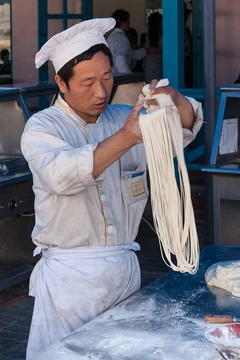
Linguine
A flat, elliptical pasta from Genoa, wider than spaghetti.

Wikipedia / Wikimedia Commons
Linguine (lit. 'little tongues'), sometimes anglicized as linguini, is a type of pasta similar to fettuccine and trenette, distinguished by its elliptical rather than flat section. Around about 4 millimetres (5⁄32 in) in width, it is wider than spaghetti, but less wide than fettuccine. Linguine originated in the city of Genoa and is based on more traditional pastas.
- type
- Pasta
- origin
- Genoa, Italy
- width
- Approximately 4 mm (5⁄32 in)
- first_documented
- 1700s
- traditional_sauce
- Pesto
- thinner_variant
- Linguettine
Lore & Background
Linguine comes from the Latin word lingua, meaning 'tongue'. The modern language closest to Latin is Italian, and the Italian word linguine, plural of the feminine linguina, means 'little tongues'. A thinner version of linguine is called linguettine.
Linguine, a type of flattened spaghetti, was initially documented in the 1700s in Genoa, Italy, by Giulio Giacchero, an economist and writer. Giacchero, author of a book on the economy of Genoa in the 1700s, wrote about linguine served with green beans, potatoes, and a Genovese specialty—basil pesto. He claimed it was the typical festive dish of Ligurian families of the 1700s.
Liguria is the coastal region in far northwest Italy on the Ligurian Sea, dominated by the ancient port of Genoa. Basil pesto is a traditional dish there, and is typically served over linguine.
Reader's Guide
Linguine's significance lies in its role as a traditional pasta of Genoa and the Ligurian region, closely tied to the iconic sauce basil pesto. Documented in the 1700s by economist Giulio Giacchero, it was described as a festive dish for Ligurian families, typically served with green beans, potatoes, and pesto. Its elliptical shape, wider than spaghetti but narrower than fettuccine, provides a flat surface area that clings well to sauces, making it particularly suited for seafood dishes—a preference noted among Neapolitans. The production of linguine involves mixing semolina or durum flour with water, rolling and cutting the dough into flat strands, a process historically done by hand. Today, dry linguine is cooked in salted boiling water for 8–10 minutes until al dente. In the United States, National Linguine Day is observed on 15 September annually, reflecting its cultural reach beyond Italy.
Did You Know?
- Linguine means 'little tongues' in Italian, from the Latin 'lingua'.
- It was first documented in the 1700s by economist Giulio Giacchero in Genoa.
- A thinner version of linguine is called linguettine.
- National Linguine Day in the United States is on 15 September.
Frequently Asked Questions
Who is Linguine?
Linguine is a pasta character from the Genoa region of Italy, first documented in the 1700s. Its name translates to 'little tongues,' and its cross-section is a small oval rather than a flat ribbon, setting it apart from similar shapes like fettuccine.
What are Linguine's powers/role?
Linguine's signature role is as the traditional bed for pesto sauce, a pairing rooted in its Genoese origins. At roughly 4 mm wide, it occupies the middle ground between spaghetti and fettuccine in width.
How does Linguine's story end?
As a staple of Italian cuisine, Linguine has no single 'ending'—it remains a widely produced and served pasta shape to this day. Its lineage traces back to older, more traditional pasta forms that predate its first written record in the 1700s.
Why is Linguine important?
Linguine matters because its elliptical cross-section gives it a slightly different bite and sauce-gripping ability compared to flat ribbons like trenette or fettuccine. It also anchors the Genoese pasta tradition and has spawned a thinner sibling called linguettine.
What's the difference between Linguine and Linguini?
They refer to the exact same pasta; 'linguini' is simply the anglicized plural form that English speakers commonly use. The Italian singular 'linguine' and the English 'linguini' point to the same 4 mm oval-crossed strand from Genoa.
More in Pasta & Noodles 1-21
Spotted an error? Know more?
This is a living reference — every entry is fact-audited, and reader corrections feed straight into our audit queue. Suggest an edit · See this site's audit record