Spaghetti
Long, thin pasta staple of Italian cuisine.

Wikipedia / Wikimedia Commons
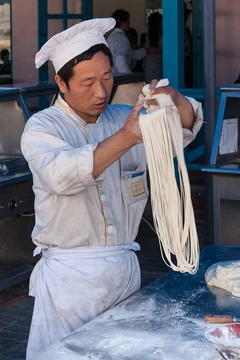
Spaghetti is a long, thin, solid, cylindrical pasta that serves as a staple food of Italian cuisine. It is made of milled wheat and water, with the standard Italian version using durum-wheat semolina. Originally notably long, shorter lengths gained popularity during the second half of the 20th century, and today it is most commonly available in lengths of 25–30 cm.
- origin
- Italy (ancient pasta existed in Italy; modern dried pasta developed in Sicily under Arab influence)
Lore & Background
Spaghetti has its roots in ancient Italy, where pasta-like foods existed long before the Middle Ages. The modern form of dried pasta, including spaghetti, was developed in Sicily under Arab influence, not directly from Persia. The first recorded appearance of thin, dried pasta occurred in Trabia, near Palermo, as documented by the geographer Al-Idrisi.
By the mid-12th century, several farms in Sicily produced itriyya at scale for local and export markets. A precise description of the manufacture of 'Sicilian macaroni' is given by Martino da Como in the later 15th century: a ball of dough stretched thin, cut with a wire as 'thin as spago (string)', dried under the sun for typically twelve days in summer. The word 'spago' had been used earlier in non-culinary contexts, and Martino's manuscript does not claim to coin the term or use 'spaghetti'. Pasta at this time was cooked for much longer than today—Martino recommends boiling very thick pasta like maccheroni for two hours to achieve a very soft texture, though this was not standard for all pasta. Contemporary ideas of serving paired soft pasta with expensive dried spices, pepper, and aged cheeses like pecorino and parmigiano, a practice rooted in the medieval medical principle of contraria contrariis curantur, which balanced pasta's cold/wet nature with hot/dry spices and cheese.
In the 17th century, the region associated with pasta expanded from Sicily to Naples. Around 1630, Naples under Spanish rule experienced famines, and as technology reduced prices, pasta became a staple food. Short cook times and firmer textures emerged, though only for fresh pasta initially; it took until the mid-19th century in Naples for cooks to take a short cook time and firm texture for granted. Pairing tomato sauces with pastas became established among the Naples populace around this time. By 1955, annual consumption of spaghetti in Italy doubled from 14 kg per person before World War II to 28 kg, and Italy produced almost 1.5 million tons of spaghetti, of which approximately 5% was exported.
Reader's Guide
Spaghetti is an emblem of Italian cuisine, with a history tracing back to ancient Middle Eastern bread traditions that evolved through Persian, Arab, and Sicilian influences into the dried pasta known today. Its significance lies in its role as a staple food that transformed from an elite item to a widely accessible commodity during the 17th century in Naples, driven by technological advances and economic pressures. The introduction of tomato sauce pairings in the late 16th to 17th centuries and the later standardization of al dente cooking in the 19th century shaped modern spaghetti dishes. The Marco Polo story, originating from a 1559 misunderstanding by Giovanni Battista Ramusio, is a persistent but inaccurate legend. Nutritionally, spaghetti provides carbohydrates, protein, iron, dietary fiber, potassium, and B vitamins, with whole-wheat versions offering more fiber. Its production involves mixing flour and water, extrusion through water-cooled dies, and careful drying to prevent brittleness. Today, spaghetti is cooked al dente in salted boiling water and served with a variety of sauces, meat, or vegetables, remaining a globally recognized symbol of Italian culinary tradition.
Did You Know?
- The name 'spaghetti' is the plural diminutive of the Italian word 'spago', meaning 'string'.
- The first recorded appearance of thin, dried pasta occurred in Trabia, near Palermo, as documented by the geographer Al-Idrisi.
- In the 15th century, Martino da Como recommended boiling Sicilian macaroni for two hours to achieve a very soft texture.
- The legend that Marco Polo brought pasta from China to Italy is a modern myth, often traced to a 1929 article in the Macaroni Journal, not to any earlier source.
Frequently Asked Questions
Who is Spaghetti?
Spaghetti is a long, thin, solid cylindrical pasta that stands as one of the most recognizable staples of Italian cooking. It is made from milled wheat—typically durum-wheat semolina—and water, giving it that characteristic firm, springy bite.
What is Spaghetti's role in the culinary world?
Spaghetti serves as a versatile canvas for sauces, from simple tomato to elaborate meat ragù, making it a centerpiece of Italian dining. Its long, thin shape is specifically designed to cling to and hold sauce effectively.
Where does Spaghetti's origin story begin?
Spaghetti's roots trace back to the Middle East, where similar noodle-making was developed in Persia before spreading to Sicily through Arab conquests. The earliest documented appearance of spaghetti-like pasta is in Trabia, near Palermo, as recorded by the geographer Al-Idrisi.
How does Spaghetti's story evolve over time?
Originally produced in notably long strands, spaghetti gradually shifted to shorter lengths during the latter half of the 20th century for practicality. Today the standard retail length sits around 25–30 cm, though variants like the thicker Spaghettoni, the finer Spaghettini, and the hair-thin Capellini cover a wide range of thicknesses.
Why is Spaghetti important to fans of pasta?
Spaghetti is the default reference point for understanding long, thin pasta, with its thickness sitting between the delicate Capellini and the robust Spaghettoni. As the most globally recognized Italian pasta shape, it anchors countless regional dishes and home-cooking traditions.
More in Pasta & Noodles 1-21
Spotted an error? Know more?
This is a living reference — every entry is fact-audited, and reader corrections feed straight into our audit queue. Suggest an edit · See this site's audit record