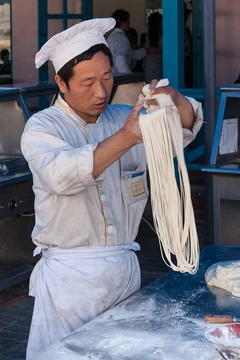
Tagliatelle
Traditional ribbon pasta from Emilia-Romagna and Marche.

Wikipedia / Wikimedia Commons
Tagliatelle are a traditional type of pasta from the Italian regions of Emilia-Romagna and Marche. They are long, flat ribbons similar in shape to fettuccine, traditionally about 6 mm wide, and are typically made with egg pasta using a ratio of one egg to one hundred grams of flour.
- field
- Culinary arts
- nationality
- Italian
- known_for
- Long, flat ribbon pasta traditionally served with meat or Bolognese sauce
- origin_regions
- Emilia-Romagna and Marche
Lore & Background
The term tagliatelle can be traced back to the Renaissance, with one of its first written records appearing in a treaty by Cristoforo di Messisbugo, steward of the House of Este in Ferrara, published in 1549. Tagliatelle are also mentioned in 1593 among the main pasta shapes by the humanist Tommaso Garzoni. A glass case in the Bologna chamber of commerce holds a solid gold replica of a piece of tagliatella, demonstrating the correct width of 8 mm when cooked, equivalent to 6.5–7 mm uncooked, depending on the hardness of the dough.
Reader's Guide
Tagliatelle are significant as a traditional pasta shape from the Italian regions of Emilia-Romagna and Marche, with documented origins in the Renaissance. Their porous and rough texture makes them ideal for thick sauces, particularly meat-based sauces like Bolognese, though they can also be served with vegetarian options such as breadcrumbs and nuts, eggs and cheese, or tomatoes and basil. The existence of a solid gold replica in the Bologna chamber of commerce underscores the cultural importance placed on the precise dimensions of the pasta. Tagliatelle's legacy is tied to its role in classic Italian cuisine, especially as the traditional accompaniment to Bolognese sauce, and its continued production using the historic egg pasta ratio.
Did You Know?
- The word tagliatelle comes from the Italian word tagliare, meaning 'to cut'.
- A solid gold replica of a tagliatella is displayed in the Bologna chamber of commerce to show the correct width.
- Tagliatelle are traditionally made with a ratio of one egg to one hundred grams of flour.
- One of the first written records of tagliatelle appears in a 1549 treaty by Cristoforo di Messisbugo.
Frequently Asked Questions
What is Tagliatelle?
Tagliatelle is a traditional Italian pasta cut into long, flat ribbons roughly 6 mm wide. It is most commonly prepared as an egg pasta, using one egg per 100 grams of flour.
Where does Tagliatelle originate from?
Tagliatelle hails from the Emilia-Romagna and Marche regions of Italy, where it has been a staple of local home cooking for generations.
How is Tagliatelle different from fettuccine?
Although both are flat ribbon pastas, Tagliatelle is typically a touch narrower and is specifically tied to the egg-pasta traditions of Emilia-Romagna and Marche, while fettuccine is more closely associated with Roman cuisine.
What sauce is Tagliatelle traditionally served with?
The classic pairing is a rich, slow-cooked meat ragù—most famously Bolognese sauce—though it also holds up well with hearty mushroom or other meat-based sauces.
What is the standard egg-to-flour ratio for Tagliatelle dough?
Traditional Tagliatelle calls for one egg per 100 grams of flour, which gives the dough a richer, more tender bite compared to plain semolina pastas.
More in Pasta & Noodles 1-21
Spotted an error? Know more?
This is a living reference — every entry is fact-audited, and reader corrections feed straight into our audit queue. Suggest an edit · See this site's audit record