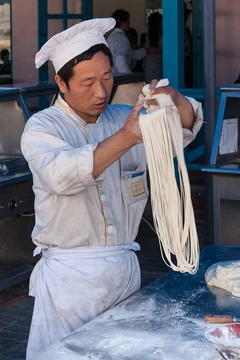
Pasta
A staple food of Italian cuisine with ancient origins.
Pasta is a type of food typically made from an unleavened dough of wheat flour mixed with water or eggs, formed into sheets or other shapes, and cooked by boiling or baking. It is a staple food of Italian cuisine, with many historians believing that pasta in a form recognizable today was introduced to Italy through Sicily in the Middle Ages as a result of Mediterranean trade networks.
- field
- Culinary staple
- known_for
- Staple food of Italian cuisine; divided into dried and fresh categories; over 310 specific forms with over 1,300 documented names
- earliest_english_appearance
- 1830s
- etymology
- From Italian pasta, meaning 'paste', from Late Latin pasta, from Greek pastē, meaning 'barley porridge'
Lore & Background
Pasta is divided into two broad categories: dried (pasta secca) and fresh (pasta fresca). Most dried pasta is produced commercially via extrusion, while fresh pasta is traditionally handmade. Both types come in numerous shapes and varieties, with 310 specific forms known by over 1,300 documented names. In Italy, names often vary by locale; for example, cavatelli has 28 different names depending on the region.
Historians note that ancient Mediterranean cultures produced dough-based foods similar to pasta, such as lagana mentioned in 1st-century writings of Horace. The 2nd-century writer Athenaeus of Naucratis provides a recipe for lagana attributed to Chrysippus of Tyana. An early 5th-century cookbook describes a dish called lagana with layers of dough and meat stuffing, an ancestor of modern lasagna. However, these early preparations were fried or baked, not boiled.
Noodle-making traditions spread from China along the Silk Road to Central Asia and reached Persia by the fourth or fifth century. In Persia, they were known as laksha. This food later reached Sicily and Spain through Arab influence, where noodles were known as itriya. The 12th-century geographer Muhammad al-Idrisi mentions itriyya manufactured and exported from Norman Sicily. The first concrete information on pasta products in Italy dates to the 13th or 14th centuries.
Reader's Guide
Pasta's significance lies in its role as a foundational element of Italian cuisine and its global spread through trade and migration. The article notes that dried pasta became popular in the 14th and 15th centuries for its easy storage, enabling it to be carried on ships during exploration. Industrial production began in the 17th century in Naples with rudimentary machines, and by 1740 the first pasta factory license was issued in Venice. The 19th century saw watermills and stone grinders used to separate semolina from bran, expanding the market. In 1859, Hungary's first pasta factory opened in Pest, and by 1867 the Buitoni Company in Tuscany was an established manufacturer. During the early 1900s, artificial drying and extrusion processes enabled greater variety and larger volumes for export. The popular belief that Marco Polo introduced pasta to Italy is considered a myth by many historians, with alternative theories crediting Arab influence in Sicily. The first written record of pasta with tomato sauce appears in a 1790 cookbook by Roman chef Francesco Leonardi.
Did You Know?
- Pasta comes in 310 specific forms known by over 1,300 documented names.
- The word pasta first appeared in English in the 1830s, from Italian pasta meaning 'paste'.
- The first written record of pasta with tomato sauce dates from the 1790 cookbook L'Apicio Moderno.
- The popular belief that Marco Polo introduced pasta to Italy is considered a myth by many historians.
Frequently Asked Questions
What is Pasta?
Pasta is an unleavened dough-based food made from wheat flour combined with water or eggs, shaped into various forms, and prepared through boiling or baking. It serves as a staple of Italian cuisine and is broadly categorized into dried and fresh varieties.
Where did Pasta originate?
Many historians trace the introduction of pasta in its recognizable modern form to Sicily during the Middle Ages, likely arriving through Mediterranean trade networks. Its roots in Italian culinary tradition stretch back quite far.
How many shapes of Pasta exist?
There are over 310 distinct pasta forms, with more than 1,300 documented names across various regions and traditions. This enormous variety is one of what makes pasta so versatile in the kitchen.
What does the word 'Pasta' actually mean?
The term derives from the Italian word meaning 'paste,' which itself comes from Late Latin pasta and ultimately from the Greek pastē, referring to a barley porridge. So the name essentially points back to a simple, thick mixture.
When did 'Pasta' first show up in English?
The word made its earliest recorded appearance in English during the 1830s. Before that, the food had existed in Italy for centuries without the term being commonly used in English-language writing.
More in Pasta & Noodles 1-21
Spotted an error? Know more?
This is a living reference — every entry is fact-audited, and reader corrections feed straight into our audit queue. Suggest an edit · See this site's audit record