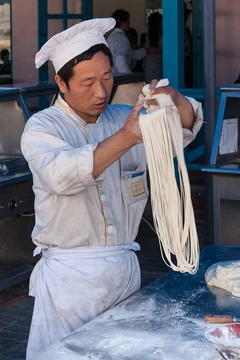
Rice noodles
Noodles made from rice flour and water, common in Asia.
Rice noodles are noodles made with rice flour and water as the principal ingredients. Sometimes ingredients such as tapioca or corn starch are added to improve transparency or increase the gelatinous and chewy texture. They are most common in the cuisines of China, India and Southeast Asia, and are available fresh, frozen, or dried, in various shapes, thicknesses and textures.
- origin
- China (Qin dynasty)
- principal_ingredients
- Rice flour and water
- common_additives
- Tapioca or corn starch
- forms
- Fresh, frozen, dried
- common_regions
- China, India, Southeast Asia
- shelf_life_fresh
- Several days
Lore & Background
The origin of rice noodles dates back to China during the Qin dynasty when people from northern China settled the south. Due to climatic conditions, northern Chinese traditionally preferred wheat and millet which grew in cold weather, while southern Chinese preferred rice which grew in hot weather. Noodles were traditionally made from wheat and eaten throughout northern China, so to adapt, northern cooks tried to prepare 'noodles' using rice, thus inventing rice noodles. Over time rice noodles and their processing methods have been introduced around the world, becoming especially popular in Southeast Asia. In India, idi-appam, strings of cooked rice, was known in ancient Tamil country around 1st century AD, as per references in the Sangam literature, according to food historian K. T. Achaya.
Reader's Guide
Rice noodles are a staple in many Asian cuisines, appearing in a vast array of dishes across Burma, Cambodia, China, the Philippines, Indonesia, Laos, Malaysia, South India, Sri Lanka, Singapore, Thailand, and Vietnam. Their versatility is reflected in numerous varieties, including round thick noodles like bánh canh and lai fun, flat thick noodles such as bánh phở and shahe fen, thin varieties like khanom chin and rice vermicelli, and others like mixian. Dishes range from soups like phở and mohinga to stir-fries like pad thai and char kway teow. The shelf life of fresh noodles is highly perishable, but can be extended by drying, as studied by the International Food Research Journal. Rice noodles also serve as an alternative to wheat flour-based noodles for individuals who react poorly to gluten, with pasta made from brown rice flour available in health food stores in Western nations.
Did You Know?
- Rice noodles were invented during the Qin dynasty when northern Chinese cooks adapted to southern rice-growing regions.
- In India, idi-appam (strings of cooked rice) was known in ancient Tamil country around the 1st century AD, per Sangam literature.
- Fresh rice noodles are highly perishable, with a shelf life of just several days.
- Studies on drying rice noodles to extend shelf life were conducted by the International Food Research Journal.
More in Pasta & Noodles 1-21
Spotted an error? Know more?
This is a living reference — every entry is fact-audited, and reader corrections feed straight into our audit queue. Suggest an edit · See this site's audit record